September 2025
Project Update
Welcome back to the City Food Policy Project update. Over the past several months we wrapped up our information gathering interviews focusing on distributors currently supplying NYC agencies. We also engaged our international advisors to capture global perspectives on values-based public food procurement. While we will continue to consult with supply chain actors for validation, our primary effort now is applying insights from the three focal supply chains—dry beans, culled dairy/beef, and leafy greens—into our developing model.
From Qualitative to Quantitative
The modeling team spent the first year and a half of the project building the modular infrastructure to support multiple commodities (and potentially other cities in the future). They then shifted their focus to more precisely building out relationships and decision-making along the supply chain, including integrating data. The model will produce a set of output indicators identified as important by the Mayor’s Office of Food Policy, the New York State Department of Agriculture and Markets, and the research team. These indicators will provide decision-makers with information about the impacts and tradeoffs of our seven modeled scenarios that explore changes such as bidding that may favor local food production, minority and women-owned businesses, or those businesses that hire locally.
In order to make sure that the model appropriately and realistically simulates the behavior of agents (e.g., farmers, processors, distributors, and NYC agencies), the CFPP team has brought the modeling and qualitative teams together to:
- Identify potential gaps or uncertainties in the model, where interview information can plug in holes, and where additional information is needed;
- Create a sufficiently representative list of agents (businesses along the supply chain) to apply and quantify the data collected to the overall sector;
- Categorize each agent based on their role and location along the supply chain; and
- Develop rules about how different agents are likely to respond to different types of food policies, such as implementing 10% price premiums for sourcing NYS or organic product.
The following is the approach that we took this spring to complete (or at least make progress on!) the four actions listed above:
- Identify representative dry bean processors, copackers, and last mile/broadline distributors and schedule interviews for spring/summer 2025.
- Create a master list of “local food” suppliers identified as businesses that supplied NYC agencies in 2022 and 2023 through the NYC Dashboard, those that submitted bids to NYC agencies, and those that are included in the NYS Department of Agriculture and Markets and Cornell Cooperative Extension Harvest New York’s list of farm to school suppliers. Then, cross reference this list with those on the SimplyAnalytics database (we gained access through the SC Johnson College of Business at Cornell). In other words, we are working to identify a list of agents in the model that either currently work with NYS grown or processed products or are more interested in so doing.
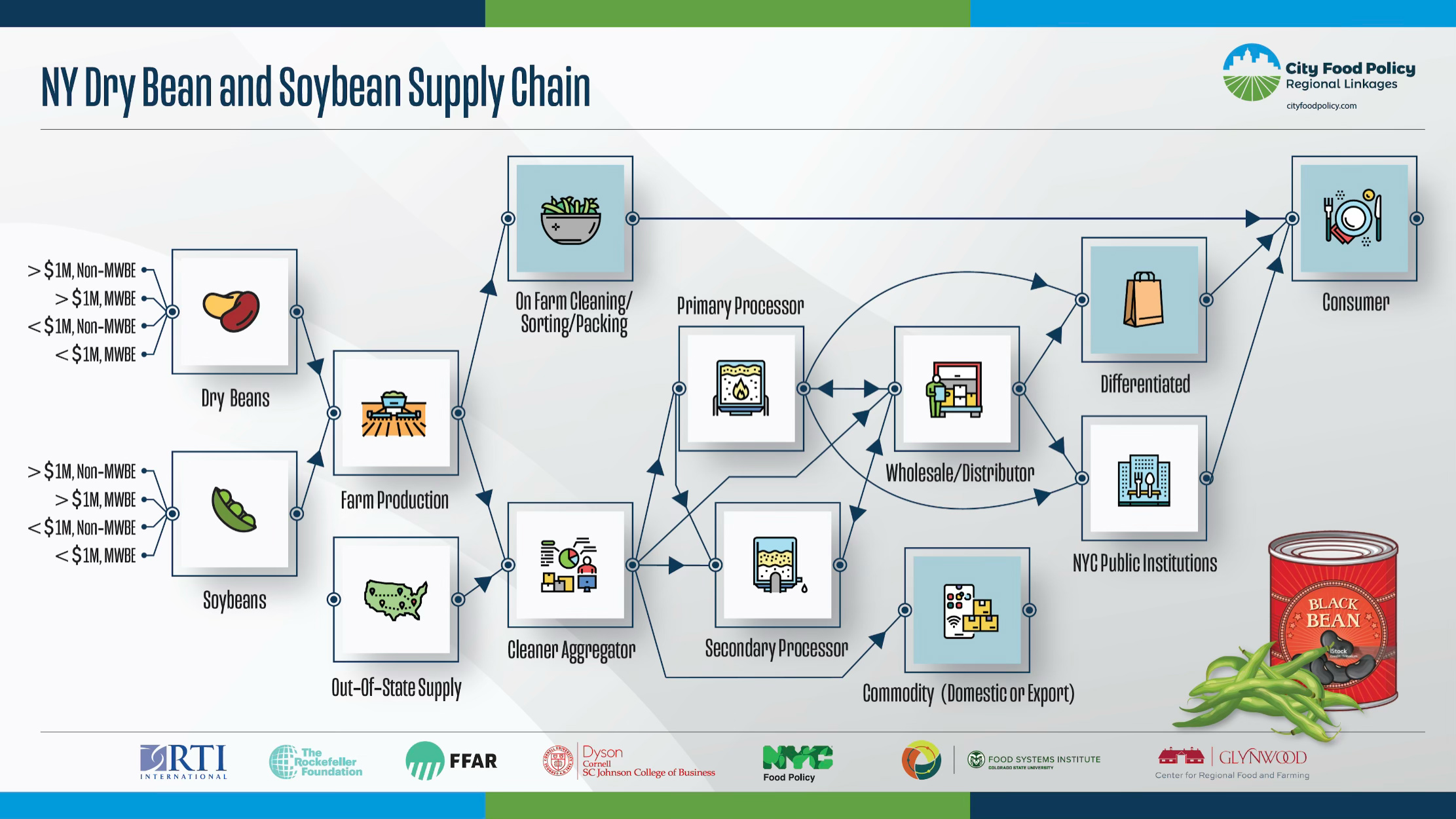
- Clarify each agent’s role along the supply chain. For beans this is farmer, cleaner/aggregator, primary processor (co-packer or canner), secondary processor, and distributor.
- Convene an all-day session at partner Glynwood Center for Regional Agriculture and, based on the interviews and focus group, make “rules” about how, when, and in what proportions supply chain agents respond to different policy actions (e.g., at a premium of 10% for organic beans, dry bean aggregators are X% more likely to sell to those markets).
At the same time that the above-mentioned work is taking place, there are two other key outputs led by the modeling team. Randy Boone is leading the team to create a web-based tool that will allow anyone to compare model outcome indicators for the seven scenarios. Users may consider the utility of different approaches to food procurement and their effects on different supply chain members (the supply chain map below depicts this information flow). Jasmine Dillon is leading work on a life cycle assessment, wherein she and her team calculate the environmental impact indicators associated with different production and transportation systems. To date, most work has focused on farm-gate environmental impact indicators. Data used to understand yields, fertilizer use, manure application, etc. come from a variety of sources, including from our producer and supply chain advisors and informants to best reflect the realities in New York State.
In the next quarter, the team will begin to ground truth both the overall model and the web-based tool with our regional partners, local bean producers, extension personnel in the state, and city staff to ensure that the model accurately reflects NYS realities.
Looking Beyond New York
Since the start of the City Food Policy Project, the values-based public food procurement (VBPFP) implementation experiences of other cities in the US and internationally has been valuable for the work in New York City and region. Since the CFPP Advisors group was established in the fall of 2023 there have been many useful insights and lessons learned. Interviews were conducted this Spring and Summer with advisors and other experts on the factors influencing urban values-based procurement policies around the world. Candidates for interviews were selected from municipal governments, research organizations, funders, research and nongovernmental organizations, supply chain experts and international organizations. Interviewees are from North and South America, Europe and Africa. Criteria for selection of candidates include direct experience with VBPFP policy, programs and research. The purpose of the interviews is to better understand the factors and approaches to shaping implementation and evaluation of outcomes of potential policy actions. The findings from interviews will help document how cities around the world are approaching the development and implementation of VBPFP. Questions include what values are selected and why, policy tools and mechanisms for implementation, engagement with regional stakeholders, evaluation practices, tradeoffs and co-benefits of values, and where future research is needed. In addition to identifying themes for exploration in future advisors’ meetings and gatherings, findings from the interviews will inform the design of a future international research project. We are working to design this future project with a number of city partners, as well as coalition networks and organizations including the School Meals Coalition, the One Planet Network’s Sustainable Public Food Working Group, the UN Food and Agriculture Organization, UN-Habitat, the Milan Urban Food Policy Pact Secretariat, ICLEI, GAIN, and RUAF, among others.
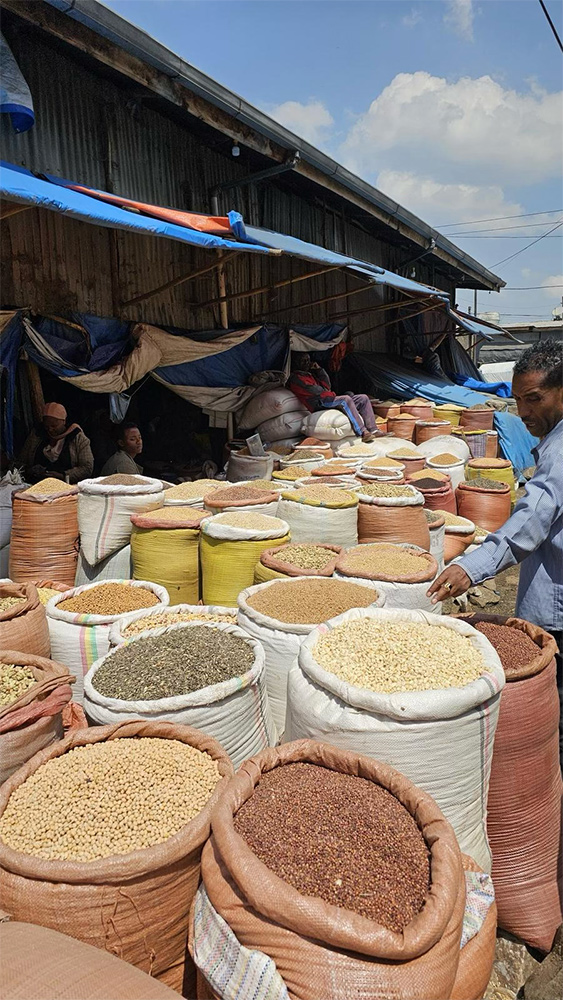
In July the UN hosted a stocktake (UNFSS+4) on progress in global food systems transformation took place in Addis Ababa, Ethiopia (image was taken at a visit to a market in Addis Ababa). CFP Lead Becca Jablonski, NYC MOFP Executive Director Kate MacKenzie and new CFP advisors Juliana Tangari and Ann Trevenen-Jones attended an event titled “Nourishing the Future through Regenerative School Meals” hosted by the Rockefeller Foundation on Saturday. There were numerous other events including several events including one co-organized with CFP team members and advisors on the role of local, traditional and farmers markets to strengthen urban and territorial food systems. Here is the full UNFSS+4 program.
As described in the April 2025 What’s New, the Workshop on Accelerating Sustainable Food Procurement with Enhanced Understanding of Tradeoffs and Opportunities for Regional Partnerships took place in Copenhagen in August. The City Food Policy Project, in partnership with the City of Copenhagen, organized a one-day workshop centered on the policy actions and implementation by five participating cities. The cities were Barcarena (Brazil), Copenhagen (Denmark), Milan (Italy), Nairobi (Kenya), and New York (US). The workshop summary will soon be available on the CFPP website. Following the workshop was a three-day learning experience led by the City of Copenhagen including visits to “food schools”, school and hospital kitchens, and to a farm that supplies organically grown grains to schools in Copenhagen. Another highlight was a culinary training by chefs who have been training chefs in organic healthy meal preparation for both public sector and private food services. The four-day visit was followed by an “Organic Denmark” summit at which Betina Madsen, Milagros de Hoz, and Becca Jablonski spoke about the role of values-based public food procurement in the larger context of municipal food policy. The findings from the workshop on VBPFP will form the basis for a parallel session in the Milan Urban Food Policy Pact Global Forum in Milan, Italy from 13-17 October. The session is titled “Assessing economic, social and environmental impacts of municipal food procurement policies: The role of participatory action research”. This session was a proposal led by CFPP with many partners whose representatives are advisors to work of CFPP. As a formal part of the program, it is likely that there will be cities attending from many regions around the world.
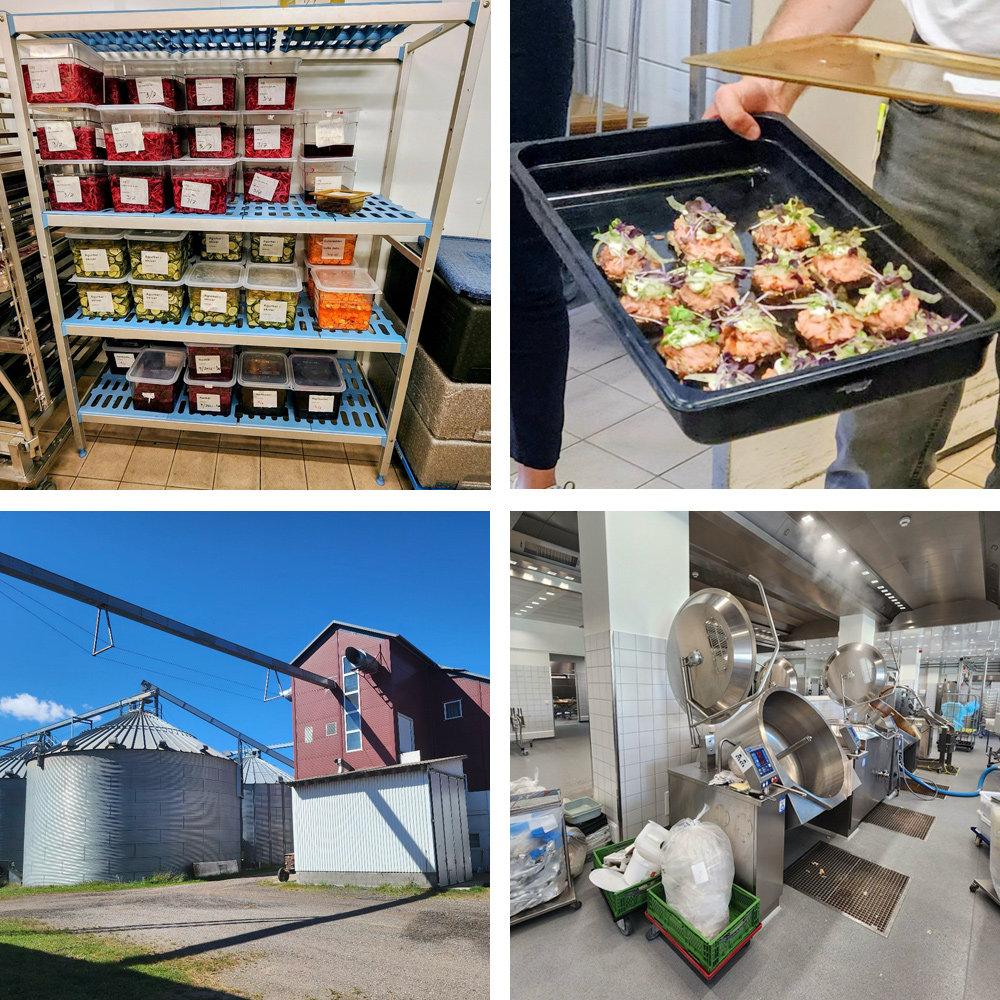
In order left to right, top to bottom –
1) Fermentation Room and 2) Smorrebrod for lunch at the Bispebjerg Hospital; 3) Mejnert’s Farm and 4) Eat Central Kitchen supplying Copenhagen’s schools.
The importance of applying these values for meals in schools, hospitals and other public institutions, as well as in private markets including local, traditional, and farmers markets is likely to continue to gain importance globally. For example, policies and practices related to VBPFP that will be included in upcoming global events, such as the Milan Urban Food Policy Pact Global Forum and the Committee on World Food Security this October, are part of a much larger growing interest in cities around the world. The need for more research and evaluation support for VBPFP will likely grow as well. Stay tuned for future newsletters on what happens next!
Where to Find Us
In the coming months the CFPP Team will be sharing its work and participating in conversations that address values-based procurement and the potential applicability of the CFPP methodology in other cities, including the role of regional stakeholders and supply chains in shaping VBPFP policy.
Climate Week
Here in New York, parallel to the 80th United Nations General Assembly, NYC Climate Week will host over 40 events on climate and food, some of which are hybrid: https://www.climateweeknyc.org/event-search/food
September 24, 2025
Reducing Food Waste for a Sustainable Food System
Hosted by Deloitte – 10:30am-11:15am
September 25, 2025
Nourishing People, Planet, and our Future
Hosted by Food Tank – 9:00am-12:10pm
MUFPP Global Forum Parallel Session
Assessing economic, social and environmental impacts of municipal food procurement policies.
Milan, Italy – October 13-17
In our next What’s New, CFPP will share our learnings from Climate Week, Copenhagen, and the latest from the modeling team. Follow this link to receive regular updates about CFPP.