January 2025
Project Update
Wishing everyone a happy and peaceful 2025!
The CFPP Team hit the ground running in the new year, continuing its modeling of the NYS Dry Bean supply chain and beginning to lay out its “salad-bar” green and cabbage supply chain strategy. Focus groups will be held across the state this winter with stakeholders to verify those two supply chains, identify the bottlenecks involved in getting products to market, and to understand the margins and profitability as well as the keys to decision-making within each stage of the process. In our next Quarterly Update, we will share the early findings including supply chain maps and margins.
Late fall 2024 included hosting and facilitating convenings across project participants. One of these events was a listening session that brought together the culled dairy/beef and dry bean industry leaders advising the CFPP with representatives from NYC responsible for setting food policy and food contracts for NYC Agencies. The goals for the day were to:
- Establish rapport between the rural/food business sector advising the CFP Project and NYC MOFP and Agency Representatives; and,
- Discuss the challenges and opportunities farms and food businesses face serving institutional markets in New York State.
The Convening was an incredible afternoon spent sitting around a table with our culled dairy/beef and dry bean advisors and individuals involved in menu design and contracting for New York City agencies. Every sector of the supply chain was present, and it was fascinating to observe the dynamic exchange both within each sector as well as across the food businesses and NYC Agency representatives. During our initial focus groups and interviews in the spring and summer, farmers and food businesses expressed concerns about perceived indifference from NYC towards NYS farms and farming communities. While there were a couple of tense moments in that room, it was evident that both groups truly wanted a better understanding of one another’s realities and needs, and that they could and should be working to inform one another. From all participants, there was renewed commitment to work to expand opportunities to serve NYS-produced foods in NYC agencies. CFPP will continue to create spaces for these types of exchanges to take place, as the issues are complex, and meaningful impact on policy and new market opportunities requires continuous informed dialogue.
The following day members of the CFPP team attended the Inaugural Farm 2 School Summit in Syracuse, NY, which was hosted by the New York State Department of Education and Cornell Cooperative Extension-Harvest NY. Interest in this conference was evident given participation by more than 500 individuals from across every segment of New York’s farm to school ecosystem, including those working in the kitchens and cafeterias every day who are often overlooked, underpaid, and yet are some of the most essential workers in the food movement. Conference attendees participated in sessions that addressed NYS incentives for local purchasing, equity and food justice, menu design and the how to’s of selling to schools, and also heard an incredible history and evolution of school food and how it must act as a driver for an “economy of care” for those working along its supply chain. The trade floor brought together buyers and vendors of all types, from organic grains to meatballs to string cheese, and the delicious meals served throughout the conference all came from those vendors and adhered to the federal child nutrition meal pattern. Who said that school food can’t be healthy and taste good!
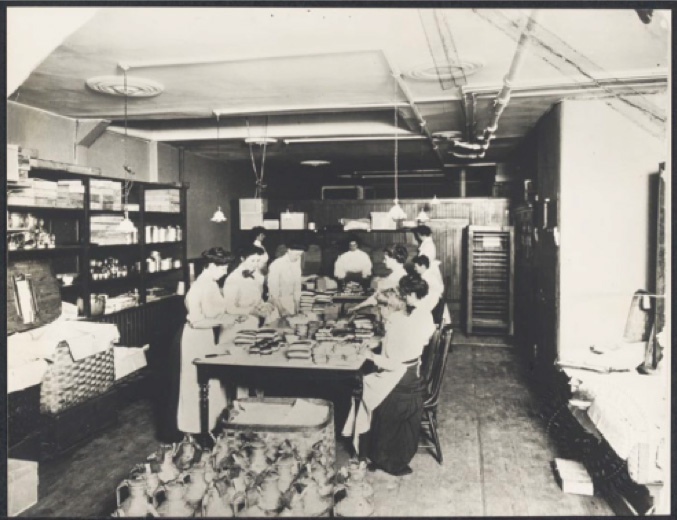
Photo was included in Dr. Jennifer Gadus’s Keynote and depicts NYC’s earliest school meals.
Harvest-NY Farm to School Lead Cheryl Bilinski and NYC Farm to School Coordinator SJ Whelan, who led the planning of the Summit, play an integral role in CFPP’s supply chain work. They bring an expertise that is unparalleled, and a working knowledge informed by their transformative daily work. Among the many hats that she wears, Cheryl has her hands in all things institutional state-wide and manages an incredible team of specialists. SJ plays an indispensable role supporting the NYC Department of Education’s efforts to purchase from NYS farms and food businesses, establishing herself and Harvest NY as a vital resource to those businesses as well. She engages with the City’s menu planners and contract developers, advises both parties on product creation, and hand holds businesses through the labyrinth of bid responses, delivery logistics, and product sourcing.
At the Summit, SJ joined a CFPP organized panel, including CFPP members Michael Hurwitz (Landing Lights Strategies, Inc and CFPP Supply Chain and Communications Lead) and Milagros De Hoz (Deputy Director, NYC MOFP), as well as the Executive Director of Administration for the NYC DOE Office of Nutrition Services (ONS) Robert Deschak, ONS Menu Planer Nicole Bonica, and Ashley Tulley of Hudson Harvest, a NYS distributor supplying institutions, for a conversation about the intricacies of providing nearly 1 million daily meals and the ABC’s of how decisions are made, and of the values and competing interests guiding those processes along the supply chain.
Good Food Purchasing For NYC: Legal Considerations and Key Terms Report by Aiden
In October CFPP team members Aiden Irish (Independent Consultant) and Tia Schwab (formerly with the Mayor’s Office of Food Policy and now with C40 Cities) released a report detailing the legal and political setting of the CFPP. It begins with a summary of the proposed values-based procurement policies that are under consideration by NYC and the process by which these policies were selected, then reviews key federal, New York State, and NYC laws and policies that influence municipal food procurement, and it ends with a review of each values-based procurement policy under consideration and specific laws and policies that guide their implementation. The NYC procurement landscape is incredibly complicated and this report highlights the various influences, challenges, and opportunities NYC faces as it implements values-based procurement.
Looking Beyond New York
As part of its ongoing communications, CFPP highlights global efforts and research around values-based procurement and urban-rural linkages.
The months following the September NYC Climate Week events saw a closely packed series of global events addressing food, biodiversity, climate change and land. Sustainable public and private procurement — including food — is increasingly recognized as an essential demand-driven tool with high impact potential to strengthen resilience at landscape and regional scales.
In October the Committee on World Food Security had the first substantive debate on urban and peri-urban food systems with the launch of a High Level Report on “Strengthening Urban and Peri-Urban Food Systems to Achieve Food Security and Nutrition in the Context of Urbanization and Rural Transformation”. The power of public food procurement was specifically addressed.
All three of the United Nations Rio Conventions on Biodiversity (CBD), Climate Change (UNFCC), and Desertification (UNCCD) met between October and December. Here too, the importance of public procurement to link food purchases to enhance biodiversity, to reduce emissions, adapt to climate change, and restore land and ecosystems was recognized as a critical tool.
The Convention to Combat Desertification (UNCCD) was the last of the three COPs to meet this year and saw the launch of a Primer on Urban-Rural Linkages and Land focused on governance frameworks and tools to restore degraded ecosystems. One of many tools described in the Primer is public food procurement and New York’s research on public food procurement to support regional agriculture is included as a case study.
Global recognition of the role of public food procurement in terms of its impact across the urban-rural continuum has come of age together with recognition of the role of local and regional governments. This is not accidental. The organizations and colleagues engaged in the City Food Policy Project from the US and international advisors and colleagues were active in planning and attending many events in 2024 including those mentioned here.
One pressing challenge in aligning public and private procurement practices for solutions for the health of land, biodiversity and climate change is the need to understand the tradeoffs between procurement policies and practices to support these goals — while also providing access to nutritious foods for all. This is the work of the CFPP featured in a 9 December webinar hosted by the One Planet Network Sustainable Public Food Procurement Interest Group. Milagros de Hoz and Becca Jablonski from the CFPP presented with the Rockefeller Foundation’s Alex Payne. The objective of the interest group is to support the development and implementation of sustainable public food procurement policies that promote sustainable food systems. De Hoz started the presentation talking about the work that the NYC Mayor’s Office of Food Policy is leading to support values-based food procurement. Payne then discussed Rockefeller’s Good Food work and what excites them about the City Food Policy project. Jablonski discussed how the CFPP is working to understand tradeoffs associated with food procurement decisions and invited broader discussions about the replicability of the research.
Where to Find Us
In the coming months the CFPP Team will be sharing its work and participating in conversations that address values-based procurement, the role of cities and regions in stewarding biodiversity, as well as the relationship between urban-rural linkages and land tenure.
- January 18, NOFA-NY Conference, SUNY Morrisville
- February 6th, (1st Annual) Cornell Organic Grains Conference, Geneva, NY
- February 25th, 11th Annual Hudson Valley Value-Added Grain School, Poughkeepsie, NY
- March 6th, The Teaching Kitchen workshop at Second Chance Foods, Brewster, NY. Strategies to integrate NYS grains and beans into kitchens and menus. Workshop for Institutional kitchens, (schools, food access programs, etc.) For questions email [email protected]
In our next What’s New, CFPP will report back from those convenings and share its findings about New York State’s cabbage and “salad bar” greens supply chain. Follow this link to receive regular updates about CFPP.